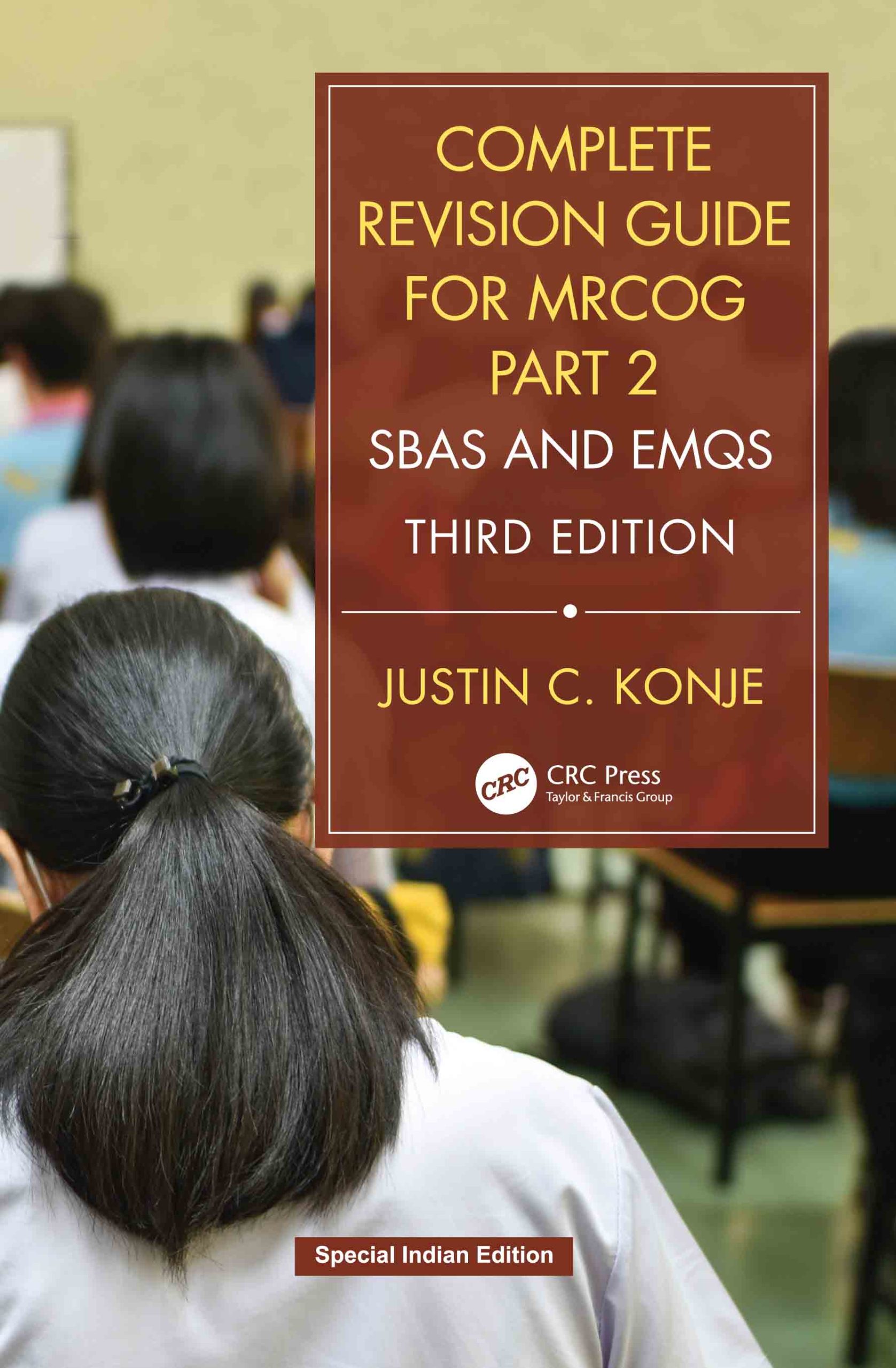
The Examination for membership of the Royal College of Obstetricians and Gynecologist (MRCOG) remains one of the most internationally recognised postgraduate examinations in the specialty. Over the years, the examination has evolved in keeping with changes in medical education; the past 2 examination now consists of two papers made up of single Best Answer (SBA) questions and Extended Matching Questions (EMQ). This invaluable resource consists of 400 SBA questions (200 in Obstetrics and 200 in Gynecology ), followed by 400 EMQs (200 in Obstetrics and 200 in Gynecology), grouped into papers, to provide enough material to guide preparations and to give some practice experience of the examination formats. All the questions have answers with explanations and sources of evidence. In Preparing for the examination, candidates should make repeated reference to these sources of evidence. There is also general advice on hoe to prepare for the examination and discussion of the reasons why trainees fail the examination.
| Categories: | All, distributed, Obstetrics and Gynecology |
|---|
| Weight | 450 kg |
|---|---|
| Dimensions | 20 × 14 × 4 cm |
Related products
-
COVID – 19 VACCINES A Comprehensive Overview
₹1,595.00We are amid a pandemic that continues to smoulder almost everywhere with raging fire off and on at different places. It has not only devastated hundreds of thousands of families who lost someone to the virus and affected over 300 million people directly, it has affected all 7.9 billion of us in some way or other. At the same time, humanity has risen well to the pandemic challenges. It was realized very early during the current outbreal that safe and effcacious vaccines would be crucial in tackling the pandemic. The unprecedented global collaboration among all stakeholders: Scientists, pharmaceutical industry, funding agencies and Governments demonstrated what a global will could do: hundreds of vaccine candidates developed, and vaccine deployment started within 12 months of isolation of new virus something that takes over a decade otherwise.
-
John Studd’s Current Progress in Obstetrics and Gynaecology Volume 7
₹1,225.00In Contemporary Obstetrics and Gynaecology, what new trends have evolved, what new advancements have been made, what new technologies have been developed, what new challenges do we face? Current Progress in Obstetrics and Gynaecology will continually answer those questions for you. Volume 7 comprises several topics at the cutting edge of contemporary Obstetrics and Gynecology. First, this volume starts with applications of artificial intelligence (AI) in reproduction medicine and how AI may lead to paradigm shift in this field. Another paradigm – changing topic involves population genetic screening for individualized preventative medicine. This volume addresses a spectrum of gynecologic topics, from dyslipidemia in pregnancy, obesity and reproduction, modern concepts of managing climacteric and menopause, treatment options for overactive bladder and the use of mesh treatment for urogynaecology. There are also chapters dealing with prevention and management of gynaecologic cancers such as those of the cervix and the endometrium. This volume updates new advancement and pratice in obstetric and gynaecological techniques, such as cervical cerlage in modern obsteric practice, routine third trimester scan for the detection of foetal anomalies and now to reduce complications in laparoscopic surgery. Last but not least, this volume addresses third gender gynaecology, the obstetric and gynaecologic care for transgender patients and the increasing use of cosmatic gynaecology in recent years. The editors are grateful to all the authors who have given their expertise and enabled this volume to improve the care of obstetric and gynaecologic patients throughout the world.
-
Current Progress In Nephrology Volume 3
₹1,995.00In the third volume of Current Progress in Nephrology, recent advances in different areas of kidney disease have been authored by eminent clinicians. The first few chapters discuss the genetics of renal development, regenerative medicine in relation to kidney, molecular diagnostics. Newer diagnostic modalities like functional magnetic resonance imaging, point of care ultrasonography and electron microscopy of organised deposits in kidney diseases are discussed in the subsequent 3 chapters. Diagnosing and managing difficult conditions of chronic kidney disease like, hepatorenal syndrome, pregnancy related renal problems, and scleroderma crisis are discussed in appropriate chapters. Anaemia, usually associated with CKD, is a significant cause of left ventricular hypertrophy and cardiovascular disease. The guidelines for correcting anaemia with iron supplementation and erythropoietin stimulating agents are provided in an appropriate chapter. Autosomal dominant rubulointerstitial kidney disease, a frequent cause of progressive CKD often remains an underdiagnosed condition and has been highlighted in one nice review. Understanding another a rare condition, thrombotic miocroangiopathy is important since it may lead to endstage renal disease or death, if not identified and appropriately treated in time.
-
HANDBOOK OF DERMATOLOGIC DRUG THERAPY 2/Ed. Revised & Updated
₹1,495.00Dermatology is a branch of medicine which relies heavily on outpatient treatment and also managing several incapacitating diseases as inpatients. The load of patients in any dermatology OPD is ever increasing, thanks to the recent awareness about the dermatological diseases. The role of a Dermatologist is complicated and quite demanding with reference to innumerable diseases that he has to deal with. Added to this, he is also expected to be well versed with all the drugs that he prescribes, what with constant addition of newer drugs. It is humanly impossible to remember and recollect the various indications, dosages, formulations, side effects and mechanism of actions of all the drugs that he is suppose to use. Another perennial threat is that posed by drug interactions. Books available on this subject are either very exhaustive or less informative. Handbook of Dermatologic Drug Therapy is published is an attempt to bridge this gap. In this second edition, newer therapies like biologics has been added. Each chapter has been updated to add the recent advances. The book is designed and written in a simple language and is not pocket heavy. The target readers are undergraduate, postgraduate and the practicing dermatologists alike. The contents of the book follow a standard format like chemical structure, mechanism of action, pharmacokinetics, indications, contraindications, side effects. Two other highlights of this book are prescription pearls and important drug interactions.


Be the first to review “Complete Revision Guide for MRCOG Part 2 SBAs and EMQs 3/ed.”