
Niedermeyer’s Electroencephalography: Basic Principles, Clinical Applications, and Related Fields, Seventh Edition keeps the clinical neurophysiologist on the forefront of medical advancements. This authoritative text covers basic neurophysiology, neuroanatomy, and neuroimaging to provide a better understanding of clinical neurophysiological findings. This edition further delves into current state-of-the-art recording EEG activity both in the normal clinical environment and unique situations such as the intensive care unit, operating rooms, and epilepsy monitoring suites. As computer technology evolves, so does the integration of analytical methods that significantly affect the reader’s interpretations of waveforms and trends that are occurring on long-term monitoring sessions. Compiled and edited by Donald L. Schomer and Fernando H. Lopes da Silva, along with a global team of experts, they collectively bring insight to crucial sections including basic principles of EEG and MEG, normal EEG, EEG in a clinical setting, clinical EEG in seizures and epilepsy, complementary and special techniques, event-related EEG phenomena, and shed light on the future of EEG and clinical neurophysiology. Akin to an encyclopedia of everything EEG, this comprehensive work is perfect for neurophysiology fellows, as well as neurology, neurosurgery, and general medical residents, and for the interns and medical students, and is a one-stop-shop for anyone training in EEG or preparing for neurophysiology or epilepsy board exams.
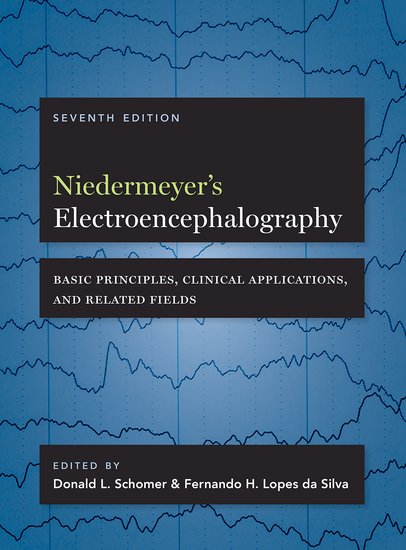
Niedermeyer’s Electroencephalography: Basic Principles, Clinical Applications, and Related Fields
₹34,800.00
| Weight | 3.630 kg |
|---|---|
| Dimensions | 28.7 × 22.61 × 5.33 cm |
Customer Reviews
There are no reviews yet.
Related products
-
Current Progress in Orthopedics Volume 1
₹1,500.00The book disseminates orthopedic knowledge and shares the experience and skill of the best orthopedic surgeons from around the world. The aim of the book with almost 60 contributing authors which covers the subjects from Pediatric Orthopedics to Arthroplasty for the Aging Population and from Cartilage Repair to Open Fracture and Spine Surgery.
-

HANDBOOK OF DERMATOLOGIC DRUG THERAPY 2/Ed. Revised & Updated
₹1,495.00Dermatology is a branch of medicine which relies heavily on outpatient treatment and also managing several incapacitating diseases as inpatients. The load of patients in any dermatology OPD is ever increasing, thanks to the recent awareness about the dermatological diseases. The role of a Dermatologist is complicated and quite demanding with reference to innumerable diseases that he has to deal with. Added to this, he is also expected to be well versed with all the drugs that he prescribes, what with constant addition of newer drugs. It is humanly impossible to remember and recollect the various indications, dosages, formulations, side effects and mechanism of actions of all the drugs that he is suppose to use. Another perennial threat is that posed by drug interactions. Books available on this subject are either very exhaustive or less informative. Handbook of Dermatologic Drug Therapy is published is an attempt to bridge this gap. In this second edition, newer therapies like biologics has been added. Each chapter has been updated to add the recent advances. The book is designed and written in a simple language and is not pocket heavy. The target readers are undergraduate, postgraduate and the practicing dermatologists alike. The contents of the book follow a standard format like chemical structure, mechanism of action, pharmacokinetics, indications, contraindications, side effects. Two other highlights of this book are prescription pearls and important drug interactions.
-
Current Progress In Nephrology Volume 1
₹1,500.00The aim of the book is to address the basic concepts and newer developments in selected areas of clinical nephrology, dialysis and renal transplantation. Selected topics on interest with reference to recent developments, updated classifications or advances in pathogenesis and treatment. Nephrologists from around the world have contributed to this one of its kind book.
-
Manual of Clinical Endocrinology 2/Ed.
₹995.00Algorithms provide a logical, concise and cost-effective approach to medical reasoning: utilizing a concise, step-by-step approach based upon clues from the history, physical examination and laboratory studies, algorithms help avoid excessive unnecessary procedures and testing. The 2nd edition of Manual of Clinical Endocrinology deals with practical issues ranging from simple thyroid function testing and thyrotoxicosis to approaching a patient with suspected thyrotoxicosis. Algorithms are simple and effective tools for the practitioner in a hurry and since the majority of the intended audience, physicians, general practitioners and postgraduates have very little time amidst their busy clinical routine, this manual uses algorithms. Twenty-two clinical issues are covered by an algorithmic approach, breaking down long lists and tables of differential diagnosis into smaller, more manageable ones. Common clinical symptoms, signs and laboratory abnormalities are classified as they present themselves at the patient’s bedside. This manual is an attempt to provide the busy practitioner with a desktop reckoner which will be useful while approaching a patient with a suspected endocrine problem. The authors have strived to be practical not pedantic – at the same time have made great effort to ensure that the recommendations are evidence based.
-
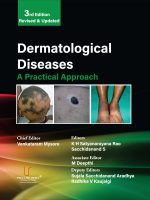
Dermatological Diseases A Practical Approach 3/Ed. – Revised & Updated
₹1,595.00Dermatology has grown much since the release of the second edition, with several advances in different fields suchh as lasers, biologics, drug therapy, dermoscopy. But the most notable change has been the change in profile, with emphasis on procedural dermatology and visibility on social media. The new 3 rd Edition reflects these changes and is therefore a thoroughly revised edition. Several new images have been added to make it more illustrative. However, the emphasis on clarity in a reader- friendly manner. Therefore the emphasis on text boxes, schematic diagrams, and flow charts continues. A new addition is the list of suggested reading, MCQs and case reports for each chapter. The Following quote form previous edition is still relevant: Writing of a book is like sawing a saw- it sharpens the mind and freshens the knowledge and is thus a process that gives immense satisfaction and joy. This satisfaction and joy will be greater if the readers too find it a valuable tool to enhance their knowledge.



Be the first to review “Niedermeyer’s Electroencephalography: Basic Principles, Clinical Applications, and Related Fields”