
Prepare with confidence for your Final FRCEM examination with OSCE Revision for the Final FRCEM, Covering over 100 topics. the book is mapped to the curriculum for the Royal College of Emergency Medicine and is structured by the domains in the syllabus. Ideal for helping you practice in pairs or groups, each topic starts with a clinical situation for the candidate, instructions for an actor or a revision buddy, and a mark sheet so you can score yourself effectively against the FRCEM criteria. Each question contains a pie chart to demonstrate how the marks will be assigned, so you know where to focus your efforts. Topics include learning points, so you can learn about the nuances of the stations and improve your answer next time. References to guidelines or evidence-based rules are included to further your study. Written by a team of authors who have successfully passed their FRCEM examination, OSCE Revision for the Final FRCEM will give you all the essential tips, insights, and guidance you need for a thorough exam preparation.
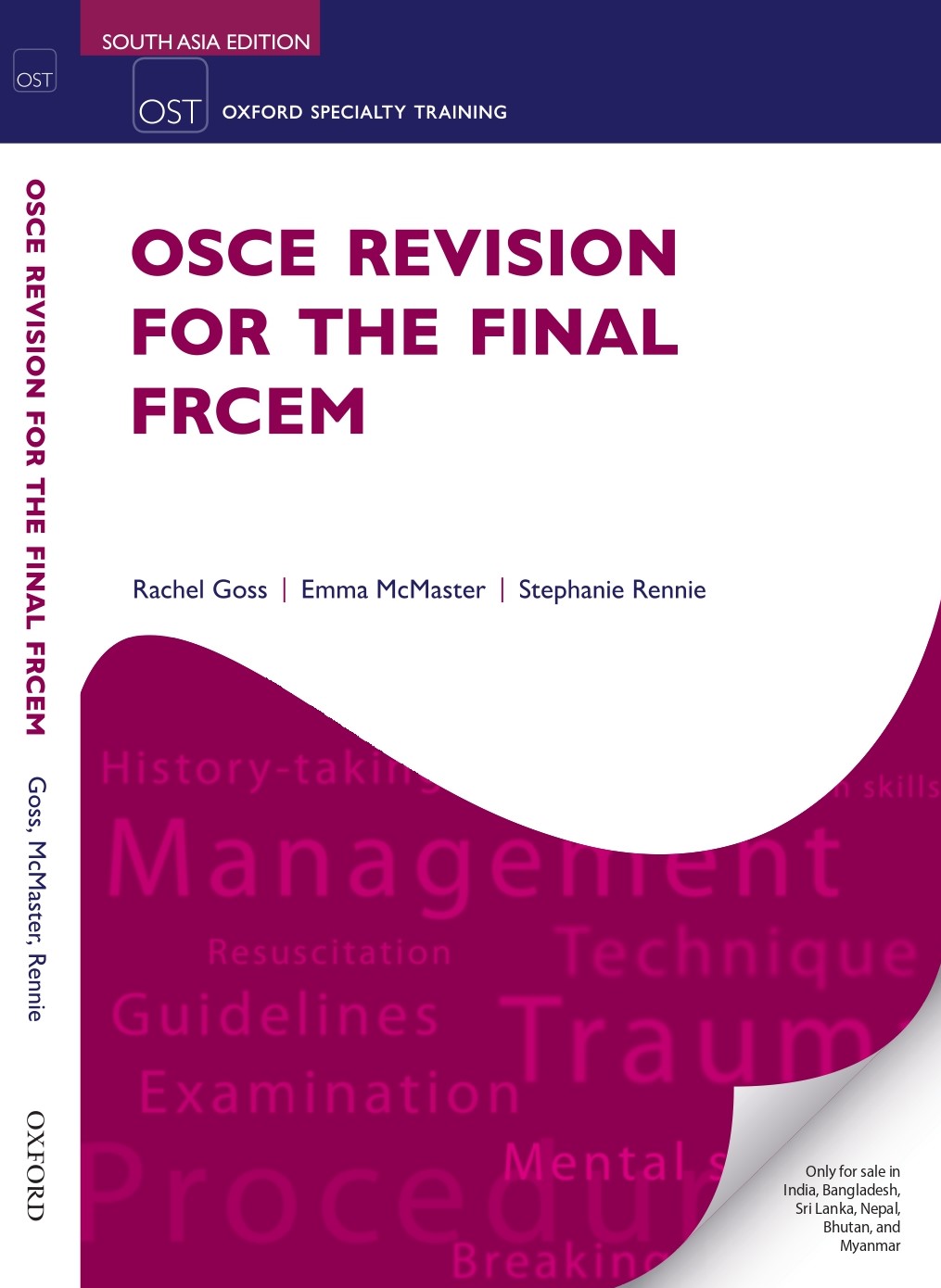
OSCE REVISION FOR THE FINAL FRCEM
₹995.00
Customer Reviews
There are no reviews yet.
Related products
-
Clinician’s Handbook of Diabetes 3/Ed.
₹675.00Case -based approach is one of the most used and most effective formats to present medical information and is the foundation for developing evidence – based treatment protocols. In its third edition, the Clinician’s Handbook of Diabetes Mellitus covers a wide range of case studies in diabetology with each case including history, investigations, differential diagnosis and discussion, critique, practice points as well as references.
-
Puzzling Cases in Stroke
₹1,250.00Stroke is the leading cause of permeant disability , including post stroke dementia, pain, depression and personality changes. While large Clinical Trials reflect information about large stroke populations, the presentation of each and every stroke patient is individual and special. Currently there are only few books which illustrate case oriented discussion. This is unique book which includes common and unusual case of stroke, so as to reinforce diagnostic skills through careful analysis of individual presenting patterns, and to guide treatment decisions.
-

HANDBOOK OF DERMATOLOGIC DRUG THERAPY 2/Ed. Revised & Updated
₹1,495.00Dermatology is a branch of medicine which relies heavily on outpatient treatment and also managing several incapacitating diseases as inpatients. The load of patients in any dermatology OPD is ever increasing, thanks to the recent awareness about the dermatological diseases. The role of a Dermatologist is complicated and quite demanding with reference to innumerable diseases that he has to deal with. Added to this, he is also expected to be well versed with all the drugs that he prescribes, what with constant addition of newer drugs. It is humanly impossible to remember and recollect the various indications, dosages, formulations, side effects and mechanism of actions of all the drugs that he is suppose to use. Another perennial threat is that posed by drug interactions. Books available on this subject are either very exhaustive or less informative. Handbook of Dermatologic Drug Therapy is published is an attempt to bridge this gap. In this second edition, newer therapies like biologics has been added. Each chapter has been updated to add the recent advances. The book is designed and written in a simple language and is not pocket heavy. The target readers are undergraduate, postgraduate and the practicing dermatologists alike. The contents of the book follow a standard format like chemical structure, mechanism of action, pharmacokinetics, indications, contraindications, side effects. Two other highlights of this book are prescription pearls and important drug interactions.
-

Puzzling Cases in Pediatric Dermatology Volume 1
₹995.00The book covers 30 Unique Cases in Pediatric Dermatology written by some of the Leading Experts. The book would be highly useful to all Dermatologists, Pediatricians, Consulting Physicians, Post Graduate Students and those interested in treating Children with Dermatological Conditions
-
Current Progress In Nephrology Volume 3
₹1,995.00In the third volume of Current Progress in Nephrology, recent advances in different areas of kidney disease have been authored by eminent clinicians. The first few chapters discuss the genetics of renal development, regenerative medicine in relation to kidney, molecular diagnostics. Newer diagnostic modalities like functional magnetic resonance imaging, point of care ultrasonography and electron microscopy of organised deposits in kidney diseases are discussed in the subsequent 3 chapters. Diagnosing and managing difficult conditions of chronic kidney disease like, hepatorenal syndrome, pregnancy related renal problems, and scleroderma crisis are discussed in appropriate chapters. Anaemia, usually associated with CKD, is a significant cause of left ventricular hypertrophy and cardiovascular disease. The guidelines for correcting anaemia with iron supplementation and erythropoietin stimulating agents are provided in an appropriate chapter. Autosomal dominant rubulointerstitial kidney disease, a frequent cause of progressive CKD often remains an underdiagnosed condition and has been highlighted in one nice review. Understanding another a rare condition, thrombotic miocroangiopathy is important since it may lead to endstage renal disease or death, if not identified and appropriately treated in time.
-
Manual of Clinical Endocrinology 2/Ed.
₹995.00Algorithms provide a logical, concise and cost-effective approach to medical reasoning: utilizing a concise, step-by-step approach based upon clues from the history, physical examination and laboratory studies, algorithms help avoid excessive unnecessary procedures and testing. The 2nd edition of Manual of Clinical Endocrinology deals with practical issues ranging from simple thyroid function testing and thyrotoxicosis to approaching a patient with suspected thyrotoxicosis. Algorithms are simple and effective tools for the practitioner in a hurry and since the majority of the intended audience, physicians, general practitioners and postgraduates have very little time amidst their busy clinical routine, this manual uses algorithms. Twenty-two clinical issues are covered by an algorithmic approach, breaking down long lists and tables of differential diagnosis into smaller, more manageable ones. Common clinical symptoms, signs and laboratory abnormalities are classified as they present themselves at the patient’s bedside. This manual is an attempt to provide the busy practitioner with a desktop reckoner which will be useful while approaching a patient with a suspected endocrine problem. The authors have strived to be practical not pedantic – at the same time have made great effort to ensure that the recommendations are evidence based.


Be the first to review “OSCE REVISION FOR THE FINAL FRCEM”