
Women’s hair loss has grown to be a serious issue. Female pattern hair loss (FPHL) is the most common cause of hair loss in women. It cannot be considered just a counterpart of male androgenic alopecia (AGA) as both have distinct etiologies and pathogenesis. Although androgens are known to have a role in male AGA, it is unknown how androgens relate to FPHL. From menarche through pregnancy, nursing, and menopause, a woman experiences a range of hormonal changes that affect every part of her body, including her hair. Due to these variations, women are more vulnerable to environmental factors that function as epigenetic agents and contribute to the pathophysiology of FPHL. Dietary inadequacies such as iron deficiency are also much more common in women as compared to men. Women who lose hair may be more psychologically distressed. Early occurrences of FPHL are difficult to diagnose and are frequently mistaken for telogen effluvium, which delays the initiation of effective treatment. More than 50% of the patient’s hair has already been lost by the time they exhibit thinning consistent with Ludwig grade 1, which hinders the therapeutic response. Therefore, treating women with FPHL calls for an entirely different strategy. There has been a sharp increase in cases of hair loss since the COVID outbreak. Prominent female dermatologists from both national and international backgrounds have contributed to this book. This book comes from authors who were the first to establish a hair clinic in a tertiary care hospital in India three decades ago. A patient load of around 300-400 per month inspired us to do research, innovations and allowed us to gain in depth insight in trichology which has culminated into this book. All things considered, this book is a comprehensive guide for effectively managing women with FPHL.
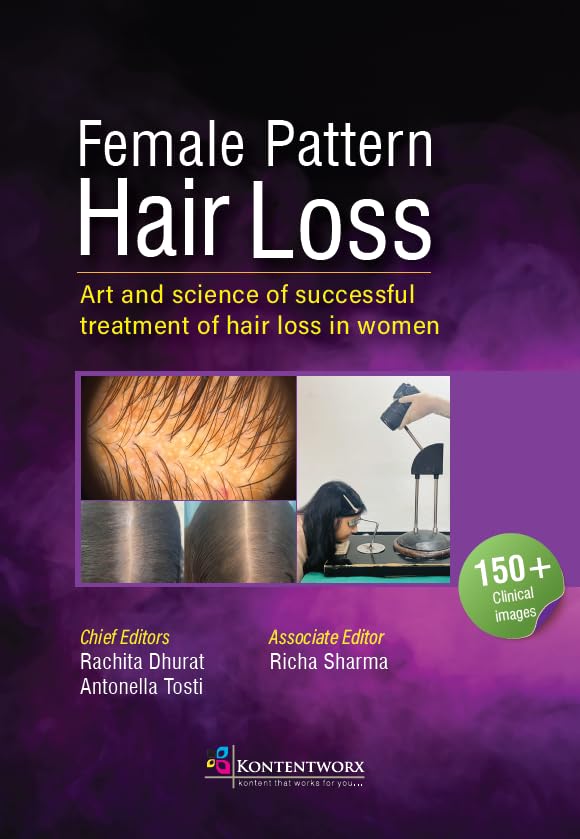
Female Pattern Hair Loss
₹1,800.00
| Weight | 410 kg |
|---|
Customer Reviews
There are no reviews yet.
Related products
-

Puzzling Cases in Nephrology
₹2,295.00This Unique book provides a glimpse of how medical mysteries can be solved, or if not solved, atleast better understood. There is much in this book that will not easily be found in modern textbooks, as this to me organizes information around case examples rather than organizing facts around disease entities. In this book cases of renal diseases and kidney transplantation of particular diagnostic or therapeutic interest have been selected. This is an essential read for Nephrologists in practice and training and all those interested in care for a Renal patient
-
Clinician’s Handbook of Diabetes 3/Ed.
₹675.00Case -based approach is one of the most used and most effective formats to present medical information and is the foundation for developing evidence – based treatment protocols. In its third edition, the Clinician’s Handbook of Diabetes Mellitus covers a wide range of case studies in diabetology with each case including history, investigations, differential diagnosis and discussion, critique, practice points as well as references.
-

Puzzling Cases in Pediatric Dermatology Volume 1
₹995.00The book covers 30 Unique Cases in Pediatric Dermatology written by some of the Leading Experts. The book would be highly useful to all Dermatologists, Pediatricians, Consulting Physicians, Post Graduate Students and those interested in treating Children with Dermatological Conditions
-

EEG Simplified
₹1,255.00EEG Simplified is an interesting and informative book, it has been written in simple english and discusses various aspects of electrophysiology with clarity. Beginning with basic recording concepts of EEG and the descriptions of normal EEG, the authors take us through artifacts, a very important chapter and then discuss electroencephalographic abnormalities seen in variety of neurological disorders. This kind of book on clinical neurophysiology is extremely useful for day to day clinical practice.
-
Puzzling Cases in Stroke Vol. 2
₹1,695.00Stroke is a treatable medical emergency affecting about 15 million people every year worldwide. It is the most common cause of common cause of disability globally and is the third most common cause of death. In the present times, there are effective treatment options which if given timely will benefit the patients of stroke remarkably. Therefore, correct diagnosis of acute stroke is extremely important for the clinicians to provide appropriate treatments and to ensure prevention of acute complications, including recurrent strokes. But sometimes a typical or uncommon presentation of stroke or “stroke chameleons”can lead to diagnostic dilemma. Therefore, timely diagnosis and management may be delayed. There are time – tested strategies which when strictly followed by the Neurphysician can reduce the chances of missing the correct diagnosis. Firstly, “Listen very carefully to the patient. He is telling you the diagnosis.” Clinicians should suspect stroke when the history suggests abrupt onset of neurological symptoms. Remember, Stroke is a clinical diagnosis and imaging is providing the corroboratory evidence. Secondly, a complete and systematic neurological examination should be routinely done in patients presenting with acute neurological symptoms because this might shed light on the true nature of the problem. Finally, even the most sophisticated neuroimaging tests might miss the stroke in the early hours after the event.
-
Clinical Pediatric Dermatology
₹1,350.00This book aims at bridging that gap and putting the basic concepts of pediatric dermatology together which help the dermatologists,post graduates and pediatricians understand and manage the pediatric dermatoses in India. With primary focus on beginners in pediatric dermatology and pediatricians,the conciseness and brevity of clinical notes has not been compromised. This book has been written keeping in view the interests of both pediatric dermatologists and pediatricians. In this era of sub-specialization, general pediatricians who offer primary care to children must be knowledgeable in pediatric dermatological problems.
-

EMG Simplified
₹3,250.00ABOUT THE BOOK – A concise book for practical Electroneuromyography What is it for? Electrodiagnosticians Neurology trainees Neurology practitioners Orthopedic and hand surgeons Physicians Technologists COVERS Technical as well as neurological aspects Troubleshooting paradigms Approach based on presenting symptoms Disease based discussions Considerations about the common and the uncommon Case Studies
Be the first to review “Female Pattern Hair Loss”