
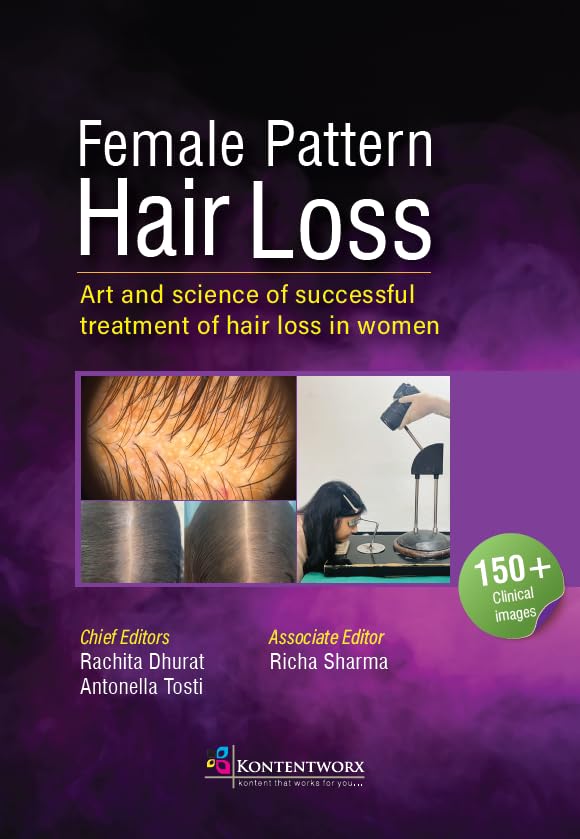
Women’s hair loss has grown to be a serious issue. Female pattern hair loss (FPHL) is the most common cause of hair loss in women. It cannot be considered just a counterpart of male androgenic alopecia (AGA) as both have distinct etiologies and pathogenesis. Although androgens are known to have a role in male AGA, it is unknown how androgens relate to FPHL. From menarche through pregnancy, nursing, and menopause, a woman experiences a range of hormonal changes that affect every part of her body, including her hair. Due to these variations, women are more vulnerable to environmental factors that function as epigenetic agents and contribute to the pathophysiology of FPHL. Dietary inadequacies such as iron deficiency are also much more common in women as compared to men. Women who lose hair may be more psychologically distressed. Early occurrences of FPHL are difficult to diagnose and are frequently mistaken for telogen effluvium, which delays the initiation of effective treatment. More than 50% of the patient’s hair has already been lost by the time they exhibit thinning consistent with Ludwig grade 1, which hinders the therapeutic response. Therefore, treating women with FPHL calls for an entirely different strategy. There has been a sharp increase in cases of hair loss since the COVID outbreak. Prominent female dermatologists from both national and international backgrounds have contributed to this book. This book comes from authors who were the first to establish a hair clinic in a tertiary care hospital in India three decades ago. A patient load of around 300-400 per month inspired us to do research, innovations and allowed us to gain in depth insight in trichology which has culminated into this book. All things considered, this book is a comprehensive guide for effectively managing women with FPHL.
Female Pattern Hair Loss
₹1,800.00
| Weight | 410 kg |
|---|
Customer Reviews
There are no reviews yet.
Related products
-
Manual of Clinical Endocrinology 2/Ed.
₹995.00Algorithms provide a logical, concise and cost-effective approach to medical reasoning: utilizing a concise, step-by-step approach based upon clues from the history, physical examination and laboratory studies, algorithms help avoid excessive unnecessary procedures and testing. The 2nd edition of Manual of Clinical Endocrinology deals with practical issues ranging from simple thyroid function testing and thyrotoxicosis to approaching a patient with suspected thyrotoxicosis. Algorithms are simple and effective tools for the practitioner in a hurry and since the majority of the intended audience, physicians, general practitioners and postgraduates have very little time amidst their busy clinical routine, this manual uses algorithms. Twenty-two clinical issues are covered by an algorithmic approach, breaking down long lists and tables of differential diagnosis into smaller, more manageable ones. Common clinical symptoms, signs and laboratory abnormalities are classified as they present themselves at the patient’s bedside. This manual is an attempt to provide the busy practitioner with a desktop reckoner which will be useful while approaching a patient with a suspected endocrine problem. The authors have strived to be practical not pedantic – at the same time have made great effort to ensure that the recommendations are evidence based.
-
Current Progress In Nephrology Volume 1
₹1,500.00The aim of the book is to address the basic concepts and newer developments in selected areas of clinical nephrology, dialysis and renal transplantation. Selected topics on interest with reference to recent developments, updated classifications or advances in pathogenesis and treatment. Nephrologists from around the world have contributed to this one of its kind book.
-
John Studd’s Current Progress in Obstetrics and Gynaecology Volume 7
₹1,225.00In Contemporary Obstetrics and Gynaecology, what new trends have evolved, what new advancements have been made, what new technologies have been developed, what new challenges do we face? Current Progress in Obstetrics and Gynaecology will continually answer those questions for you. Volume 7 comprises several topics at the cutting edge of contemporary Obstetrics and Gynecology. First, this volume starts with applications of artificial intelligence (AI) in reproduction medicine and how AI may lead to paradigm shift in this field. Another paradigm – changing topic involves population genetic screening for individualized preventative medicine. This volume addresses a spectrum of gynecologic topics, from dyslipidemia in pregnancy, obesity and reproduction, modern concepts of managing climacteric and menopause, treatment options for overactive bladder and the use of mesh treatment for urogynaecology. There are also chapters dealing with prevention and management of gynaecologic cancers such as those of the cervix and the endometrium. This volume updates new advancement and pratice in obstetric and gynaecological techniques, such as cervical cerlage in modern obsteric practice, routine third trimester scan for the detection of foetal anomalies and now to reduce complications in laparoscopic surgery. Last but not least, this volume addresses third gender gynaecology, the obstetric and gynaecologic care for transgender patients and the increasing use of cosmatic gynaecology in recent years. The editors are grateful to all the authors who have given their expertise and enabled this volume to improve the care of obstetric and gynaecologic patients throughout the world.
-

CARDIAC MRI Simplified CONCISE GUIDE
₹625.00Who Will benefit from this book? * Genuine interest in cardiovascular imaging * International certification exams * Enhancing skills in interpretations of cardiac MR Why this format? * Salient points, easier and faster to read. * Questions-answer approach for better understanding of topic. * Short and well contained guide. What are the highlights of the book? * Comprehensive coverage of all topics * Appropriate illustrations * Inclusion of recent advances
-
Puzzling Cases in Stroke Vol. 2
₹1,695.00Stroke is a treatable medical emergency affecting about 15 million people every year worldwide. It is the most common cause of common cause of disability globally and is the third most common cause of death. In the present times, there are effective treatment options which if given timely will benefit the patients of stroke remarkably. Therefore, correct diagnosis of acute stroke is extremely important for the clinicians to provide appropriate treatments and to ensure prevention of acute complications, including recurrent strokes. But sometimes a typical or uncommon presentation of stroke or “stroke chameleons”can lead to diagnostic dilemma. Therefore, timely diagnosis and management may be delayed. There are time – tested strategies which when strictly followed by the Neurphysician can reduce the chances of missing the correct diagnosis. Firstly, “Listen very carefully to the patient. He is telling you the diagnosis.” Clinicians should suspect stroke when the history suggests abrupt onset of neurological symptoms. Remember, Stroke is a clinical diagnosis and imaging is providing the corroboratory evidence. Secondly, a complete and systematic neurological examination should be routinely done in patients presenting with acute neurological symptoms because this might shed light on the true nature of the problem. Finally, even the most sophisticated neuroimaging tests might miss the stroke in the early hours after the event.
-
CASES IN CLINICAL MEDICINE CARDIOLOGY
₹1,495.00This book is a case – based approach to some of the connon clinical problems and case scenarios in cardiology encountered by clinicians on a day-to-day basis. It is a multi-author work, with contributions from some of the most reowned clinicians ans academicians in the field of Cardiology. Each chapter begins with a case scenario, and goes on to discuss the diagnostic approach, Mamagement, and key learnings for the clinicians faced with a similar case. The most contemporary evidence is reviewed, and practical algorithms suggested wherever appropriate. We have endeavored to provide a balanced coverage of the vast fields of Cardiology, with topics including ischemic heart disease, general Cardiology, congenital, valvular and structural heart disease and arrhythmias. The selected cases cover exciting new interventional techniques like TAVR, precutaneous pulmonary valve replacement, and LA appendage closure replacement., as well as recent development in coronary physiology, robotics in intervention, imaging modalities like IVUS and OCT, cardiac MRI and advanced echocardiographic techniques like strain rate imaging. A separate section on Arrhythmias deals with some common, yet therapeutically challenging, rhythm disorders seen in clinical practice.
-

Puzzling Cases in Nephrology
₹2,295.00This Unique book provides a glimpse of how medical mysteries can be solved, or if not solved, atleast better understood. There is much in this book that will not easily be found in modern textbooks, as this to me organizes information around case examples rather than organizing facts around disease entities. In this book cases of renal diseases and kidney transplantation of particular diagnostic or therapeutic interest have been selected. This is an essential read for Nephrologists in practice and training and all those interested in care for a Renal patient
-

Textbook and Atlas of Dermatology 2nd Ed.
₹3,995.00Salient Features :
1) Comprehensive visual guidance you need to effectively evaluate, diagnose and manage all forms of skin disease. over 200 images richly depict etiology, clinical features, diagnosis and treatment, equipping you to provide the best care to every patient. 2) More than 40 chapters covering all dermatological ailments. 3) More than 200 illustrations from the Author’s personal database giving a unique overview of the diseases. 4) Hands – on clinical experience sharing in the form of cases, clinical presentations and management approach.
Be the first to review “Female Pattern Hair Loss”