
Now in its 6th edition, Handbook of Drugs in intensive Care is the essential guide to using drugs safely and effectively in the intensive care setting. The book is split into two Sections – an A-Z guide to the drugs available, and concise notes on the topics and situations faced on a daily basis. The A-Z section provides succinct information on each drug including uses, limitations, administration directions and adverse effects. The second section details practice guidelines such as insulin therapy, Parkinson’s disease therapy when nil-by-mouth and drug dosing in renal failure.
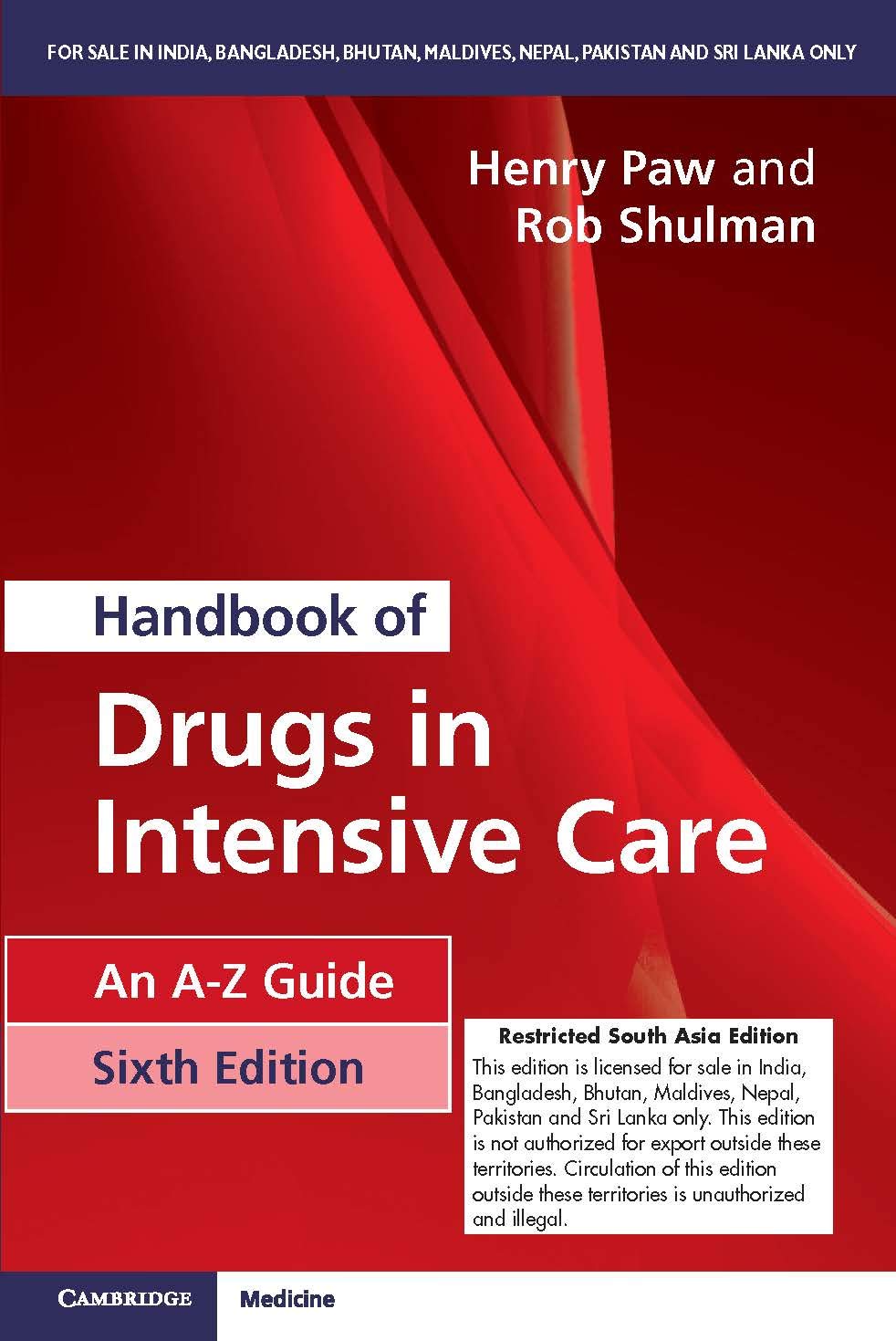
Handbook of Drugs in Intensive Care 6/Ed.
₹995.00
Now in its 6th edition, Handbook of Drugs in intensive Care is the essential guide to using drugs safely and effectively in the intensive care setting. The book is split into two Sections – an A-Z guide to the drugs available, and concise notes on the topics and situations faced on a daily basis. The A-Z section provides succinct information on each drug including uses, limitations, administration directions and adverse effects. The second section details practice guidelines such as insulin therapy, Parkinson’s disease therapy when nil-by-mouth and drug dosing in renal failure.
| Weight | 500 kg |
|---|---|
| Dimensions | 18 × 12.01 × 1.05 cm |
Customer Reviews
There are no reviews yet.
Related products
-
Puzzling Cases in Nephrology
₹2,295.00This Unique book provides a glimpse of how medical mysteries can be solved, or if not solved, atleast better understood. There is much in this book that will not easily be found in modern textbooks, as this to me organizes information around case examples rather than organizing facts around disease entities. In this book cases of renal diseases and kidney transplantation of particular diagnostic or therapeutic interest have been selected. This is an essential read for Nephrologists in practice and training and all those interested in care for a Renal patient
-
CASES IN CLINICAL MEDICINE CARDIOLOGY
₹1,495.00This book is a case – based approach to some of the connon clinical problems and case scenarios in cardiology encountered by clinicians on a day-to-day basis. It is a multi-author work, with contributions from some of the most reowned clinicians ans academicians in the field of Cardiology. Each chapter begins with a case scenario, and goes on to discuss the diagnostic approach, Mamagement, and key learnings for the clinicians faced with a similar case. The most contemporary evidence is reviewed, and practical algorithms suggested wherever appropriate. We have endeavored to provide a balanced coverage of the vast fields of Cardiology, with topics including ischemic heart disease, general Cardiology, congenital, valvular and structural heart disease and arrhythmias. The selected cases cover exciting new interventional techniques like TAVR, precutaneous pulmonary valve replacement, and LA appendage closure replacement., as well as recent development in coronary physiology, robotics in intervention, imaging modalities like IVUS and OCT, cardiac MRI and advanced echocardiographic techniques like strain rate imaging. A separate section on Arrhythmias deals with some common, yet therapeutically challenging, rhythm disorders seen in clinical practice.
-
EMG Simplified
₹3,250.00ABOUT THE BOOK – A concise book for practical Electroneuromyography What is it for? Electrodiagnosticians Neurology trainees Neurology practitioners Orthopedic and hand surgeons Physicians Technologists COVERS Technical as well as neurological aspects Troubleshooting paradigms Approach based on presenting symptoms Disease based discussions Considerations about the common and the uncommon Case Studies
-
John Studd’s Current Progress in Obstetrics and Gynaecology Volume 7
₹1,225.00In Contemporary Obstetrics and Gynaecology, what new trends have evolved, what new advancements have been made, what new technologies have been developed, what new challenges do we face? Current Progress in Obstetrics and Gynaecology will continually answer those questions for you. Volume 7 comprises several topics at the cutting edge of contemporary Obstetrics and Gynecology. First, this volume starts with applications of artificial intelligence (AI) in reproduction medicine and how AI may lead to paradigm shift in this field. Another paradigm – changing topic involves population genetic screening for individualized preventative medicine. This volume addresses a spectrum of gynecologic topics, from dyslipidemia in pregnancy, obesity and reproduction, modern concepts of managing climacteric and menopause, treatment options for overactive bladder and the use of mesh treatment for urogynaecology. There are also chapters dealing with prevention and management of gynaecologic cancers such as those of the cervix and the endometrium. This volume updates new advancement and pratice in obstetric and gynaecological techniques, such as cervical cerlage in modern obsteric practice, routine third trimester scan for the detection of foetal anomalies and now to reduce complications in laparoscopic surgery. Last but not least, this volume addresses third gender gynaecology, the obstetric and gynaecologic care for transgender patients and the increasing use of cosmatic gynaecology in recent years. The editors are grateful to all the authors who have given their expertise and enabled this volume to improve the care of obstetric and gynaecologic patients throughout the world.
-
Puzzling Cases in Electrocardiography
₹775.0012 Lead Electrocardiography remains as clinically relevant now as when first introduced to clinical medicine decades ago. The value of 12 Lead ECG is mattering the ability to integrate the ECG findings into information provided by the history and Physical Examination. The book authored by Prof Rimmerman, one of the foremost Cardiologists in the world follows 50 ECG Case Studies purposefully chosen where the ECG made a clinical impact on the management of the patient
-
Dermatological Diseases A Practical Approach 3/Ed. – Revised & Updated
₹1,595.00Dermatology has grown much since the release of the second edition, with several advances in different fields suchh as lasers, biologics, drug therapy, dermoscopy. But the most notable change has been the change in profile, with emphasis on procedural dermatology and visibility on social media. The new 3 rd Edition reflects these changes and is therefore a thoroughly revised edition. Several new images have been added to make it more illustrative. However, the emphasis on clarity in a reader- friendly manner. Therefore the emphasis on text boxes, schematic diagrams, and flow charts continues. A new addition is the list of suggested reading, MCQs and case reports for each chapter. The Following quote form previous edition is still relevant: Writing of a book is like sawing a saw- it sharpens the mind and freshens the knowledge and is thus a process that gives immense satisfaction and joy. This satisfaction and joy will be greater if the readers too find it a valuable tool to enhance their knowledge.
-

Textbook and Atlas of Dermatology 2nd Ed.
₹3,995.00Salient Features :
1) Comprehensive visual guidance you need to effectively evaluate, diagnose and manage all forms of skin disease. over 200 images richly depict etiology, clinical features, diagnosis and treatment, equipping you to provide the best care to every patient. 2) More than 40 chapters covering all dermatological ailments. 3) More than 200 illustrations from the Author’s personal database giving a unique overview of the diseases. 4) Hands – on clinical experience sharing in the form of cases, clinical presentations and management approach.
-
Be the first to review “Handbook of Drugs in Intensive Care 6/Ed.”