
Niedermeyer’s Electroencephalography: Basic Principles, Clinical Applications, and Related Fields, Seventh Edition keeps the clinical neurophysiologist on the forefront of medical advancements. This authoritative text covers basic neurophysiology, neuroanatomy, and neuroimaging to provide a better understanding of clinical neurophysiological findings. This edition further delves into current state-of-the-art recording EEG activity both in the normal clinical environment and unique situations such as the intensive care unit, operating rooms, and epilepsy monitoring suites. As computer technology evolves, so does the integration of analytical methods that significantly affect the reader’s interpretations of waveforms and trends that are occurring on long-term monitoring sessions. Compiled and edited by Donald L. Schomer and Fernando H. Lopes da Silva, along with a global team of experts, they collectively bring insight to crucial sections including basic principles of EEG and MEG, normal EEG, EEG in a clinical setting, clinical EEG in seizures and epilepsy, complementary and special techniques, event-related EEG phenomena, and shed light on the future of EEG and clinical neurophysiology. Akin to an encyclopedia of everything EEG, this comprehensive work is perfect for neurophysiology fellows, as well as neurology, neurosurgery, and general medical residents, and for the interns and medical students, and is a one-stop-shop for anyone training in EEG or preparing for neurophysiology or epilepsy board exams.
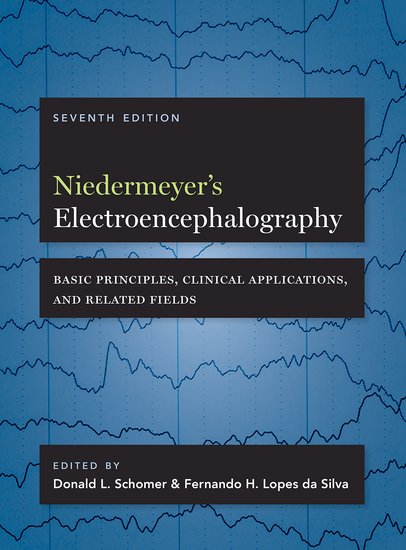
Niedermeyer’s Electroencephalography: Basic Principles, Clinical Applications, and Related Fields
₹34,800.00
| Weight | 3.630 kg |
|---|---|
| Dimensions | 28.7 × 22.61 × 5.33 cm |
Customer Reviews
There are no reviews yet.
Related products
-
Current Progress in Nephrology Volume 2
₹1,500.00The aim of the 2nd volume of this book is to address the basic concepts and newer developments in selected areas of clinical nephrology, dialysis and renal transplantation. Selected topics on interest with reference to recent developments, updated classifications or advances in pathogenesis and treatment. Nephrologists from around the world have contributed to this one of its kind book.
-

Puzzling Cases in Pediatric Dermatology Volume 1
₹995.00The book covers 30 Unique Cases in Pediatric Dermatology written by some of the Leading Experts. The book would be highly useful to all Dermatologists, Pediatricians, Consulting Physicians, Post Graduate Students and those interested in treating Children with Dermatological Conditions
-

HANDBOOK OF DERMATOLOGIC DRUG THERAPY 2/Ed. Revised & Updated
₹1,495.00Dermatology is a branch of medicine which relies heavily on outpatient treatment and also managing several incapacitating diseases as inpatients. The load of patients in any dermatology OPD is ever increasing, thanks to the recent awareness about the dermatological diseases. The role of a Dermatologist is complicated and quite demanding with reference to innumerable diseases that he has to deal with. Added to this, he is also expected to be well versed with all the drugs that he prescribes, what with constant addition of newer drugs. It is humanly impossible to remember and recollect the various indications, dosages, formulations, side effects and mechanism of actions of all the drugs that he is suppose to use. Another perennial threat is that posed by drug interactions. Books available on this subject are either very exhaustive or less informative. Handbook of Dermatologic Drug Therapy is published is an attempt to bridge this gap. In this second edition, newer therapies like biologics has been added. Each chapter has been updated to add the recent advances. The book is designed and written in a simple language and is not pocket heavy. The target readers are undergraduate, postgraduate and the practicing dermatologists alike. The contents of the book follow a standard format like chemical structure, mechanism of action, pharmacokinetics, indications, contraindications, side effects. Two other highlights of this book are prescription pearls and important drug interactions.
-
Puzzling Cases in Stroke
₹1,250.00Stroke is the leading cause of permeant disability , including post stroke dementia, pain, depression and personality changes. While large Clinical Trials reflect information about large stroke populations, the presentation of each and every stroke patient is individual and special. Currently there are only few books which illustrate case oriented discussion. This is unique book which includes common and unusual case of stroke, so as to reinforce diagnostic skills through careful analysis of individual presenting patterns, and to guide treatment decisions.
-
CARDIAC MRI Simplified CONCISE GUIDE
₹625.00Who Will benefit from this book? * Genuine interest in cardiovascular imaging * International certification exams * Enhancing skills in interpretations of cardiac MR Why this format? * Salient points, easier and faster to read. * Questions-answer approach for better understanding of topic. * Short and well contained guide. What are the highlights of the book? * Comprehensive coverage of all topics * Appropriate illustrations * Inclusion of recent advances
-

Textbook and Atlas of Dermatology 2nd Ed.
₹3,995.00Salient Features :
1) Comprehensive visual guidance you need to effectively evaluate, diagnose and manage all forms of skin disease. over 200 images richly depict etiology, clinical features, diagnosis and treatment, equipping you to provide the best care to every patient. 2) More than 40 chapters covering all dermatological ailments. 3) More than 200 illustrations from the Author’s personal database giving a unique overview of the diseases. 4) Hands – on clinical experience sharing in the form of cases, clinical presentations and management approach.
-

EEG Simplified
₹1,255.00EEG Simplified is an interesting and informative book, it has been written in simple english and discusses various aspects of electrophysiology with clarity. Beginning with basic recording concepts of EEG and the descriptions of normal EEG, the authors take us through artifacts, a very important chapter and then discuss electroencephalographic abnormalities seen in variety of neurological disorders. This kind of book on clinical neurophysiology is extremely useful for day to day clinical practice.

Be the first to review “Niedermeyer’s Electroencephalography: Basic Principles, Clinical Applications, and Related Fields”