
Women’s hair loss has grown to be a serious issue. Female pattern hair loss (FPHL) is the most common cause of hair loss in women. It cannot be considered just a counterpart of male androgenic alopecia (AGA) as both have distinct etiologies and pathogenesis. Although androgens are known to have a role in male AGA, it is unknown how androgens relate to FPHL. From menarche through pregnancy, nursing, and menopause, a woman experiences a range of hormonal changes that affect every part of her body, including her hair. Due to these variations, women are more vulnerable to environmental factors that function as epigenetic agents and contribute to the pathophysiology of FPHL. Dietary inadequacies such as iron deficiency are also much more common in women as compared to men. Women who lose hair may be more psychologically distressed. Early occurrences of FPHL are difficult to diagnose and are frequently mistaken for telogen effluvium, which delays the initiation of effective treatment. More than 50% of the patient’s hair has already been lost by the time they exhibit thinning consistent with Ludwig grade 1, which hinders the therapeutic response. Therefore, treating women with FPHL calls for an entirely different strategy. There has been a sharp increase in cases of hair loss since the COVID outbreak. Prominent female dermatologists from both national and international backgrounds have contributed to this book. This book comes from authors who were the first to establish a hair clinic in a tertiary care hospital in India three decades ago. A patient load of around 300-400 per month inspired us to do research, innovations and allowed us to gain in depth insight in trichology which has culminated into this book. All things considered, this book is a comprehensive guide for effectively managing women with FPHL.
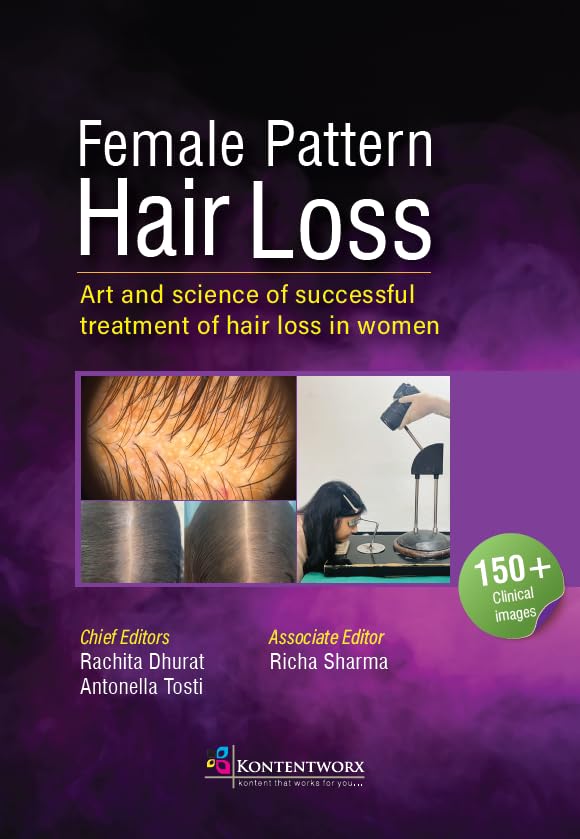
Female Pattern Hair Loss
₹1,800.00
| Weight | 410 kg |
|---|
Customer Reviews
There are no reviews yet.
Related products
-

EMG Simplified
₹3,250.00ABOUT THE BOOK – A concise book for practical Electroneuromyography What is it for? Electrodiagnosticians Neurology trainees Neurology practitioners Orthopedic and hand surgeons Physicians Technologists COVERS Technical as well as neurological aspects Troubleshooting paradigms Approach based on presenting symptoms Disease based discussions Considerations about the common and the uncommon Case Studies
-

Puzzling Cases in Nephrology
₹2,295.00This Unique book provides a glimpse of how medical mysteries can be solved, or if not solved, atleast better understood. There is much in this book that will not easily be found in modern textbooks, as this to me organizes information around case examples rather than organizing facts around disease entities. In this book cases of renal diseases and kidney transplantation of particular diagnostic or therapeutic interest have been selected. This is an essential read for Nephrologists in practice and training and all those interested in care for a Renal patient
-
Current Progress in Orthopedics Volume 2
₹1,500.00This textbook represents the second text from the Editors who have invited a panel of distinguished authors with international reputations to present the current state of the art in orthopedic surgery. There is more awareness of musculoskeletal disease as a cause of disability in every country and as governments and non-governmental organizations move to address this problem there is increasing recognition of the importance of orthopedic surgery in dealing with musculoskeletal disease. The entire spectrum from congenital abnormalities through pediatric musculoskeletal illness, trauma, sports and degenerative diseases have been covered in this volume. This is the companion volume to the first published two years ago and we anticipate further volumes in the future as we attempt to address the ever expanding role of orthopedic surgery in modern healthcare.
-

Textbook and Atlas of Dermatology 2nd Ed.
₹3,995.00Salient Features :
1) Comprehensive visual guidance you need to effectively evaluate, diagnose and manage all forms of skin disease. over 200 images richly depict etiology, clinical features, diagnosis and treatment, equipping you to provide the best care to every patient. 2) More than 40 chapters covering all dermatological ailments. 3) More than 200 illustrations from the Author’s personal database giving a unique overview of the diseases. 4) Hands – on clinical experience sharing in the form of cases, clinical presentations and management approach.
-
-
Current Progress In Obstetrics & Gynaceology – Volume 6
₹1,225.00Volume 6 of Current Progress in Obstetrics and Gynaecology has been complied during the most challenging time of the Covid – 19 pandemic. In spite of the challenges that all of us have faced thrughout the world, the editors are delighted to produce a state-of-the-art volume on many of the important challenges in contemporary obstetrics and gyaecology. The first part of this volume addresses a spectrum of gynaecologic topics, including infertility, the special challenges of female athletes, early ovarian aging, diagnosis and management of adnexal masses, endoscopic surgery, minimising blood loss in surgery and diagnosing and managing gynaecologic complications. The second part of this volume deals with myriad of obstetric topics, including epigenetics, the hormonal transition int motherhood, maternal infections leading to congenital defects, the important of multidisciplinary care in managing foetal anomalies, the evolving antenatal management of congenital diaphragmatic hernia, the current approach to antepartum haemorrhage and the important role of ultrasound in the management of labour and delivery. The volume closes with the relevance of professional ethics to the clinical practice of obstetrics and gynaecology. The editors are grateful to all of the authors who have given their expertise selflessly at this difficult time and enabled this volume to improve the care of obstetric and gynaecologic patients throughout the world.
-
CASES IN CLINICAL MEDICINE CARDIOLOGY
₹1,495.00This book is a case – based approach to some of the connon clinical problems and case scenarios in cardiology encountered by clinicians on a day-to-day basis. It is a multi-author work, with contributions from some of the most reowned clinicians ans academicians in the field of Cardiology. Each chapter begins with a case scenario, and goes on to discuss the diagnostic approach, Mamagement, and key learnings for the clinicians faced with a similar case. The most contemporary evidence is reviewed, and practical algorithms suggested wherever appropriate. We have endeavored to provide a balanced coverage of the vast fields of Cardiology, with topics including ischemic heart disease, general Cardiology, congenital, valvular and structural heart disease and arrhythmias. The selected cases cover exciting new interventional techniques like TAVR, precutaneous pulmonary valve replacement, and LA appendage closure replacement., as well as recent development in coronary physiology, robotics in intervention, imaging modalities like IVUS and OCT, cardiac MRI and advanced echocardiographic techniques like strain rate imaging. A separate section on Arrhythmias deals with some common, yet therapeutically challenging, rhythm disorders seen in clinical practice.
-
Puzzling Cases in Electrocardiography
₹775.0012 Lead Electrocardiography remains as clinically relevant now as when first introduced to clinical medicine decades ago. The value of 12 Lead ECG is mattering the ability to integrate the ECG findings into information provided by the history and Physical Examination. The book authored by Prof Rimmerman, one of the foremost Cardiologists in the world follows 50 ECG Case Studies purposefully chosen where the ECG made a clinical impact on the management of the patient

Be the first to review “Female Pattern Hair Loss”